
LLMs
Understanding LLM Architecture: From Text to Intelligence
Sep 27th 2026
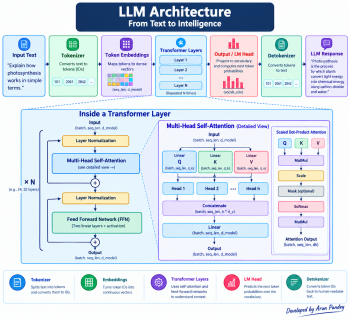
Large Language Models (LLMs) may seem complex, but their core workflow can be understood through a few key components:
1. Tokenizer** — Converts text into tokens that the model can process.
2. Token Embeddings** — Transforms tokens into numerical vectors that capture meaning and relationships.
3. Transformer Layers** — The heart of modern LLMs, using **Self-Attention** and **Feed-Forward Networks** to understand context.
4. Multi-Head Attention** — Allows the model to focus on different parts of the input simultaneously.
5. LM Head** — Converts the model's internal representation into probabilities for the next token.
6. Detokenizer** — Converts the generated tokens back into human-readable text.
The fascinating part is how these components work together repeatedly to transform a simple text prompt into a meaningful response.
Understanding this architecture is a great starting point for anyone learning Generative AI, Transformers, LLMs, and AI Engineering
Visualized and developed by Arun Pandey
Categories
Join our 5000+ Club
Get the latest updates on design, development, and technology trends right in your inbox.